WhatsApp AI vs WhatsApp Automation: What's Actually Different in 2026?

Written By
Teja
WhatsApp AI vs automation explained. Learn the difference, use cases, benefits, limitations and when businesses should use AI, automation or both.

WhatsApp AI vs WhatsApp Automation: What's Actually Different in 2026?
Businesses often use "WhatsApp AI" and "WhatsApp automation" as if they mean the same thing.
They don't.
WhatsApp automation follows rules and workflows to perform specific actions automatically.
WhatsApp AI can understand customer messages, interpret intent, generate responses and handle conversations that don't always follow a fixed path.
The simplest way to understand it is:
Automation tells WhatsApp what to do.
AI helps WhatsApp understand what the customer wants.
And in 2026, many businesses don't have to choose between them.
The strongest WhatsApp setups use both.
WhatsApp AI vs WhatsApp Automation: Quick Comparison
Feature | WhatsApp Automation | WhatsApp AI |
|---|---|---|
How it works | Follows predefined rules | Understands natural language and context |
Responses | Predefined or flow-based | AI-generated |
Customer questions | Best for predictable questions | Better for open-ended questions |
Decision making | Rule-based | Context and intent-based |
Personalization | Based on stored rules/data | Can adapt responses to conversation |
Lead qualification | Structured questions | Conversational qualification |
Follow-ups | Excellent | Can make follow-ups more contextual |
Best for | Workflows and repetitive tasks | Conversations and complex queries |
Human handoff | Rule-based | Can identify when human help is needed |
So the difference isn't:
AI vs automation.
It's:
Rules and workflows vs intelligence.
In practice, they work better together.
What Is WhatsApp Automation?
WhatsApp automation means using predefined rules, triggers and workflows to perform actions automatically.
For example:
Customer sends a message
↓
Show a menu
↓
Customer selects "Pricing"
↓
Send pricing information
↓
Customer selects "Talk to Sales"
↓
Send the conversation to an agent
Nothing needs to be manually triggered by an employee.
The workflow already knows what to do.
Automation is particularly useful when the customer journey is predictable.
What Can WhatsApp Automation Do?
Automated Welcome Messages
When someone starts a conversation, automatically send a welcome message.
Lead Qualification
Ask structured questions such as:
"What product are you interested in?"
"What is your budget?"
"When would you like to buy?"
The answers can then be passed to the sales team.
Follow-Ups
If a customer stops halfway through a flow, the system can trigger a follow-up later.
For example:
Customer starts a product enquiry
↓
Leaves the flow
↓
Send a reminder after the configured time
Drip Sequences
Businesses can create scheduled follow-ups such as:
Day 1
Day 3
Day 15
Day 30
This is useful for lead nurturing and customer retention.
Customer Journeys
Businesses can also track where customers stop inside a flow.
For example:
Ad
↓
↓
Product selection
↓
Pricing
↓
Checkout
If many customers stop at pricing, the business has something to investigate.
What Is WhatsApp AI?
WhatsApp AI adds an intelligence layer to the conversation.
Instead of requiring customers to select from predefined options, AI can understand what they actually type.
For example, a customer might write:
"I need a laptop for video editing under 80k. Which one would you recommend?"
A traditional flow may not know what to do with that sentence.
An AI system can understand:
Product category
Customer requirement
Budget
Intent
and respond accordingly.
Meta is also bringing Business AI directly to eligible WhatsApp Business users in India. Meta says the feature can answer customer questions, recommend products, capture leads, book appointments and help drive sales.
What Can WhatsApp AI Do?
Answer Natural-Language Questions
Customers don't always use the exact words your automation flow expects.
AI can interpret different ways of asking the same question.
For example:
"How much is it?"
"What's the price?"
"Can you tell me the cost?"
"Price for this?"
All mean roughly the same thing.
Understand Customer Intent
AI can identify whether someone is:
Asking a question
Looking to buy
Requesting support
Asking for a price
Comparing products
Trying to book
Asking for a human agent
Qualify Leads
Instead of forcing customers through a rigid questionnaire, AI can collect information naturally during the conversation.
Recommend Products
AI can use your business information and customer requirements to suggest relevant products or services.
Handle FAQs
AI can answer common questions using the information provided by the business.
Hand Off to Humans
AI doesn't need to handle every conversation.
When a customer needs a person, the conversation can be passed to a human agent.
WhatsApp Automation vs AI: A Simple Example
Imagine a customer sends:
"Hi, I saw your ad. I need a 2BHK apartment near the city under ₹80 lakh. Do you have anything available?"
Automation alone may require the customer to go through:
Select Property
↓
Select Location
↓
Select Budget
↓
Select Bedrooms
AI can understand the message directly.
It can identify:
Property: Apartment
Bedrooms: 2BHK
Location: City area
Budget: ₹80 lakh
Then the system can use automation to continue the journey.
AI understands the customer.
Automation executes the next steps.
That's the real difference.
Can AI Replace WhatsApp Automation?
No.
In most business use cases, AI and automation solve different problems.
AI is good at:
Understanding
↓
Interpreting
↓
Generating
↓
Adapting
Automation is good at:
Triggering
↓
Routing
↓
Scheduling
↓
Executing
For example:
AI:
"Looks like you're interested in our premium plan."
Automation:
Send premium plan details.
AI:
"You haven't completed the signup yet. Would you like help?"
Automation:
If customer says yes → open the signup flow.
This combination is much more powerful than using either one alone.
When Should You Use WhatsApp Automation?
Choose automation when the process is predictable.
Good examples include:
Welcome messages
Lead forms
Appointment booking
Order updates
Payment reminders
FAQ menus
Drip campaigns
Customer journeys
Agent routing
Follow-up sequences
If you can clearly describe the process as:
"If this happens → do this"
automation is usually the right starting point.
When Should You Use WhatsApp AI?
AI becomes more useful when customers don't follow a predictable script.
Use AI when customers:
Ask open-ended questions
Describe problems in their own words
Need product recommendations
Have different requirements
Ask multiple questions in one message
Need conversational lead qualification
Need support beyond predefined answers
If customers regularly go outside your predefined flow, AI can reduce that friction.
When Should You Use Both?
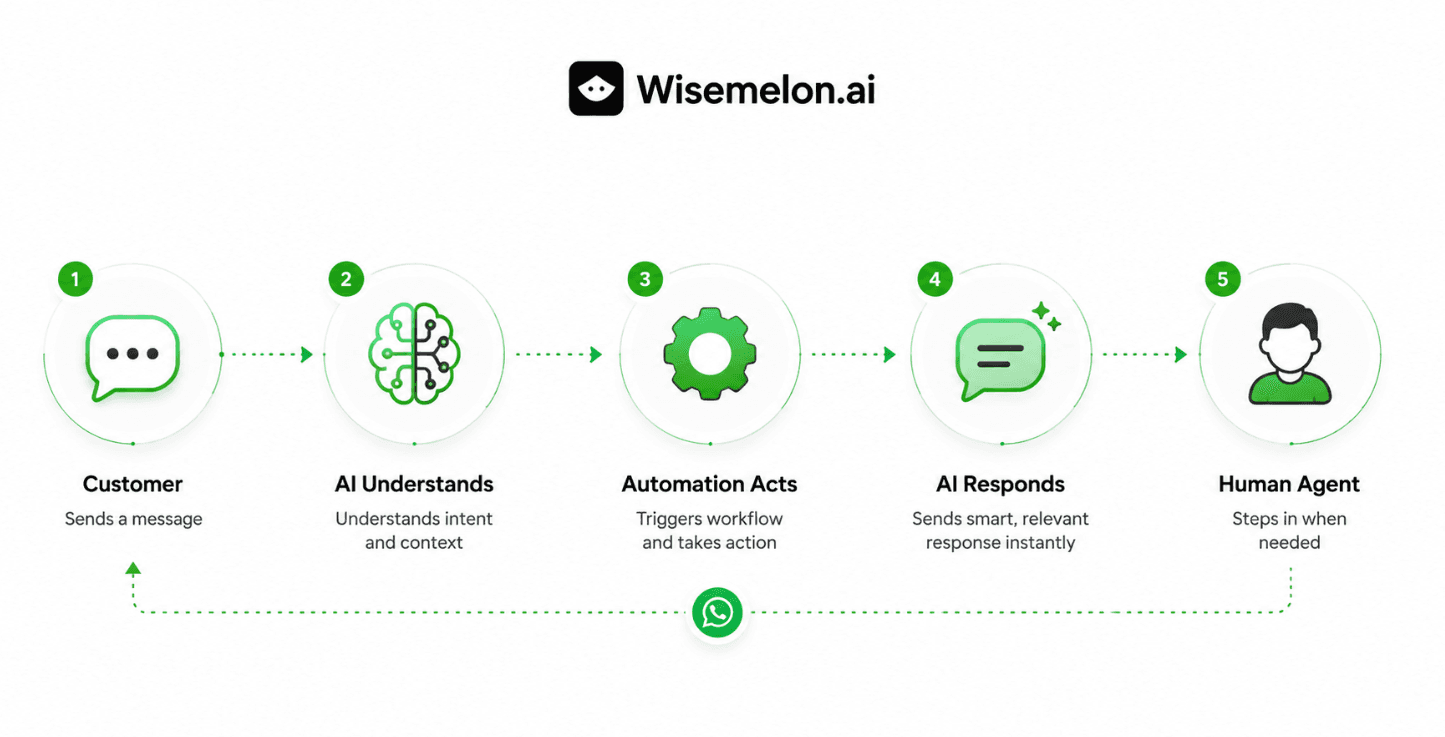
For many businesses, this is the best approach.
For example:
Customer sends a message
↓
AI understands the customer's intent
↓
Automation selects the correct journey
↓
Customer receives relevant information
↓
AI answers questions
↓
Automation schedules the next step
↓
Human agent takes over when necessary
This creates a system where AI handles the conversation while automation handles the process.
WhatsApp AI vs Automation for Marketing
This difference is particularly important in WhatsApp marketing.
Automation can handle:
Campaign scheduling
Audience segmentation
Drip sequences
Follow-ups
Customer journeys
Retargeting triggers
AI can add:
Personalized messaging
Intent detection
Lead scoring
Product recommendations
Conversational qualification
Behavior-based responses
For example:
Customer clicks an advertisement
↓
Starts WhatsApp conversation
↓
AI identifies buying intent
↓
Automation adds customer to the appropriate journey
↓
Customer receives follow-up
↓
AI answers questions
↓
Sales agent receives qualified lead
That's not AI replacing automation.
It's AI making automation more intelligent.
WhatsApp AI vs Automation: Which Is Better?
There isn't one winner.
It depends on the problem.
Choose Automation If
You have predictable processes.
You need:
Structured flows
Scheduled messages
Drip campaigns
Follow-ups
Routing
Notifications
Customer journeys
Choose AI If
Your customers ask unpredictable questions.
You need:
Natural conversations
Intent detection
Recommendations
Lead qualification
Context-aware responses
Conversational support
Choose Both If
You want:
AI for understanding
Automation for execution
Humans for complex situations
Does WhatsApp AI Need WhatsApp Automation?
Not necessarily.
AI can answer conversations by itself in supported setups.
But businesses often need more than answering questions.
They also need to:
Trigger campaigns
Move leads between stages
Schedule follow-ups
Update customer records
Route conversations
Track customer journeys
Connect other systems
That's where automation becomes important.
Does WhatsApp Automation Need AI?
No.
A business can build a complete WhatsApp automation system without AI.
For example:
Customer clicks "Book Demo"
↓
Collect name
↓
Collect email
↓
Show available options
↓
Confirm booking
↓
Send reminder
That's automation.
No AI is required.
AI becomes useful when the conversation becomes less predictable.
The Future of WhatsApp Business Is Not AI vs Automation
The more useful question for businesses isn't:
"Should we choose AI or automation?"
It's:
"Where should AI be used, and where should automation be used?"
A good WhatsApp system might look like:
Marketing campaign
↓
Customer enters WhatsApp
↓
Automation starts the journey
↓
AI understands customer intent
↓
Automation triggers the right flow
↓
AI answers questions
↓
Customer gets qualified
↓
Sales agent takes over
↓
Automation continues follow-up
Each technology has a job.
That's what makes the system effective.
What Businesses Should Look for in a WhatsApp Platform
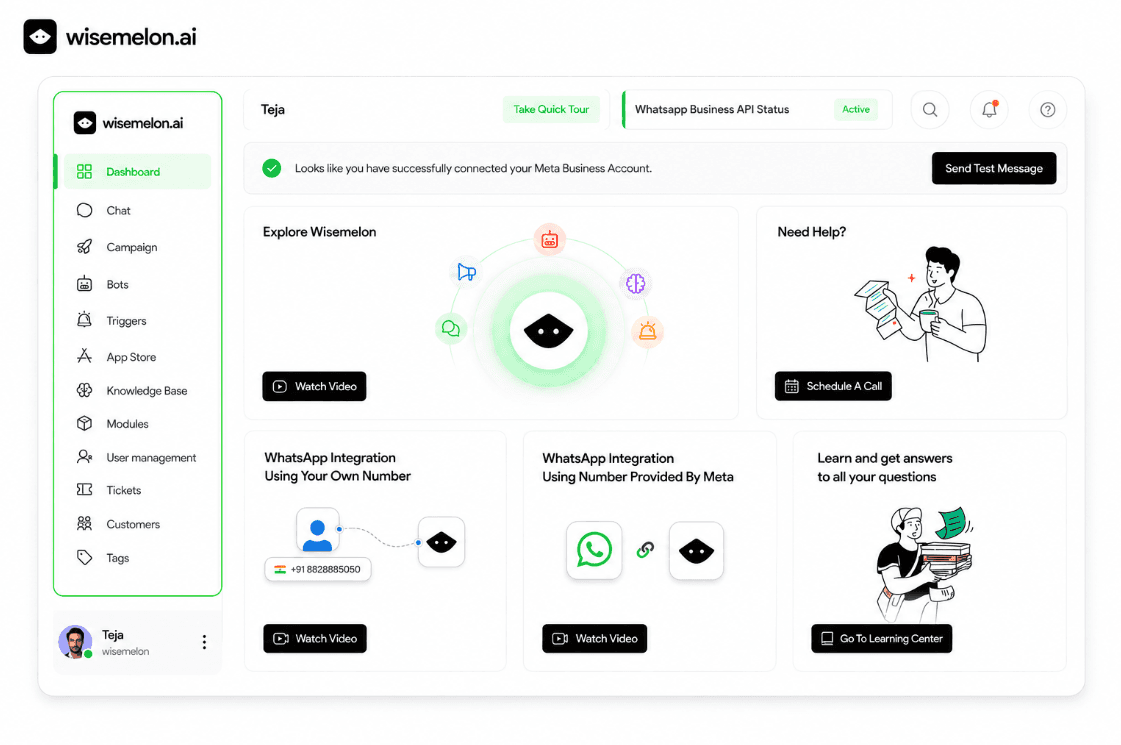
If you're evaluating a WhatsApp platform in 2026, don't look only for an "AI chatbot."
Look for the complete system.
It should support:
Official WhatsApp Business API
Campaigns
Automation
Customer journeys
AI
Lead qualification
Drip sequences
Follow-ups
Team inbox
Analytics
Integrations
Human handoff
An official WhatsApp Business API platform such as Wisemelon can combine these capabilities so businesses don't have to treat AI, campaigns, automation and customer conversations as completely separate systems.
Final Thoughts
WhatsApp AI and WhatsApp automation aren't competing technologies.
They solve different problems.
Automation is best at following rules and executing repeatable workflows.
AI is best at understanding customers and handling conversations that don't follow a fixed script.
The strongest approach is often:
AI understands.
Automation executes.
Humans handle what needs a human.
In 2026, the question isn't whether your business needs AI or automation.
It's understanding where each one actually adds value.
Frequently Asked Questions
What is the difference between WhatsApp AI and WhatsApp automation?
WhatsApp automation follows predefined rules, triggers and workflows. WhatsApp AI can understand natural-language conversations, interpret intent and generate responses. Businesses can use both together.
Is WhatsApp AI the same as a chatbot?
Not necessarily. A traditional chatbot usually follows predefined flows and rules. AI can understand more flexible, natural-language conversations and respond based on context and available business information.
Can WhatsApp automation work without AI?
Yes. Businesses can automate messages, campaigns, follow-ups, customer journeys, routing and notifications without using AI.
Can WhatsApp AI work without automation?
Yes, for certain conversational use cases. However, businesses often combine AI with automation when they need campaigns, follow-ups, routing, scheduling and customer journeys.
Which is better for WhatsApp marketing: AI or automation?
Neither is universally better. Automation is useful for campaigns, scheduled follow-ups and customer journeys. AI is useful for personalization, intent detection, recommendations and conversational lead qualification. Using both can create a more complete system.
Does WhatsApp AI replace human agents?
Not necessarily. AI can handle repetitive or straightforward conversations, while complex conversations can be transferred to human agents.
Can AI and automation be used together on WhatsApp?
Yes. AI can understand a customer's message and automation can trigger the appropriate workflow. This combination is useful for sales, marketing, support and customer journeys.
Does WhatsApp AI require the WhatsApp Business API?
The exact setup depends on the AI feature or platform being used. Businesses using third-party AI and automation platforms for scalable business messaging generally need an official WhatsApp Business Platform/API setup.
Newsletter
Enjoyed this read? Subscribe.
Discover design insights, project updates, and tips to elevate your work straight to your inbox.
Unsubscribe at any time
Written By
Teja
Updated on


