WhatsApp Marketing vs Utility Messages: Complete 2026 Guide
Compare WhatsApp marketing and utility messages by purpose, pricing, deliverability, template rules and use cases. Learn when businesses should use each category.

WhatsApp Marketing vs Utility Messages: What's the Difference?
Not every WhatsApp message a business sends has the same purpose.
A limited-time offer sent to customers is very different from an order confirmation someone is already expecting.
That difference matters because WhatsApp classifies business messages based on their purpose. Two important categories businesses need to understand are marketing messages and utility messages.
Choosing the right category affects not only template approval, but also messaging costs, customer experience, and your overall WhatsApp strategy.
WhatsApp Marketing vs Utility Messages: Quick Comparison
Factor | Marketing Messages | Utility Messages |
|---|---|---|
Purpose | Generate demand, promote or re-engage | Provide expected transactional or service information |
Customer intent | Business encourages a new action | Customer has usually already taken an action |
Examples | Offers, launches, retargeting | Order updates, payment confirmations, account updates |
Promotional content | Allowed within WhatsApp policies | Should not be used for unrelated promotions |
Pricing | Meta's applicable marketing rates | Meta's applicable utility rates |
Typical goal | Sales, engagement, reactivation | Complete or support an existing journey |
The simplest way to understand the difference is to ask:
Why are we sending this message?
If you're trying to create new demand or encourage another purchase, it's likely marketing.
If you're providing information about something the customer already ordered, requested, or initiated, it may qualify as utility.
What Is a WhatsApp Marketing Message?
Marketing messages are generally used to generate interest, encourage action, promote something, or re-engage customers.
Common examples include:
Offers
"Get 20% off your next order this weekend."
Product Announcements
"Our new collection is now available. Explore it today."
Retargeting
"Still interested in the product you explored? Complete your purchase today."
Re-Engagement
"We haven't seen you in a while. Here's a special offer for your next order."
Even if the message sounds helpful or conversational, it can still be considered marketing when its main purpose is promotional.
What Is a WhatsApp Utility Message?
Utility messages are generally connected to an existing transaction, account, order, or customer-initiated action.
Examples include:
Order Updates
"Your order #4582 has been shipped."
Payment Updates
"Your payment of ₹2,500 has been successfully received."
Delivery Updates
"Your order is out for delivery and is expected today."
Account Notifications
"Your subscription renewal has been successfully processed."
The key difference is existing customer intent.
The business is providing information the customer needs or expects rather than trying to create new demand.
Marketing vs Utility Pricing
Marketing and utility messages can have different pricing depending on Meta's current WhatsApp Business Platform pricing structure, message category, and destination market.
This difference becomes important at scale.
If a business sends thousands or millions of messages, even a small difference in messaging cost can significantly affect campaign economics.
However, businesses shouldn't choose a category simply because it costs less.
Always check Meta's current official country-specific rates - https://developers.facebook.com/documentation/business-messaging/whatsapp/pricing before calculating campaign costs rather than relying on old pricing tables or screenshots.
Which Has Better Deliverability?
Utility messages can naturally receive strong engagement because customers are often expecting the information.
Someone waiting for an order update is more likely to pay attention to:
"Your order is arriving today."
than an unexpected promotional message.
But businesses shouldn't assume utility messages have guaranteed delivery.
Delivery and engagement can depend on factors such as:
Customer engagement
Message relevance
Template quality
Messaging frequency
Account quality
WhatsApp policies
The better strategy is to send communication customers actually expect and find useful.
Why Meta May Reclassify Your Template
Businesses choose a category when submitting templates, but Meta may determine that the content belongs to another category.
For example:
"Your order has been delivered. Get 20% off your next purchase."
The first part is transactional.
The second part introduces a promotion.
Because the message is now encouraging another purchase, its classification may change.
Businesses should therefore choose categories based on the actual purpose of the communication, not the category they would prefer to pay for.
Can You Turn a Marketing Message Into Utility?
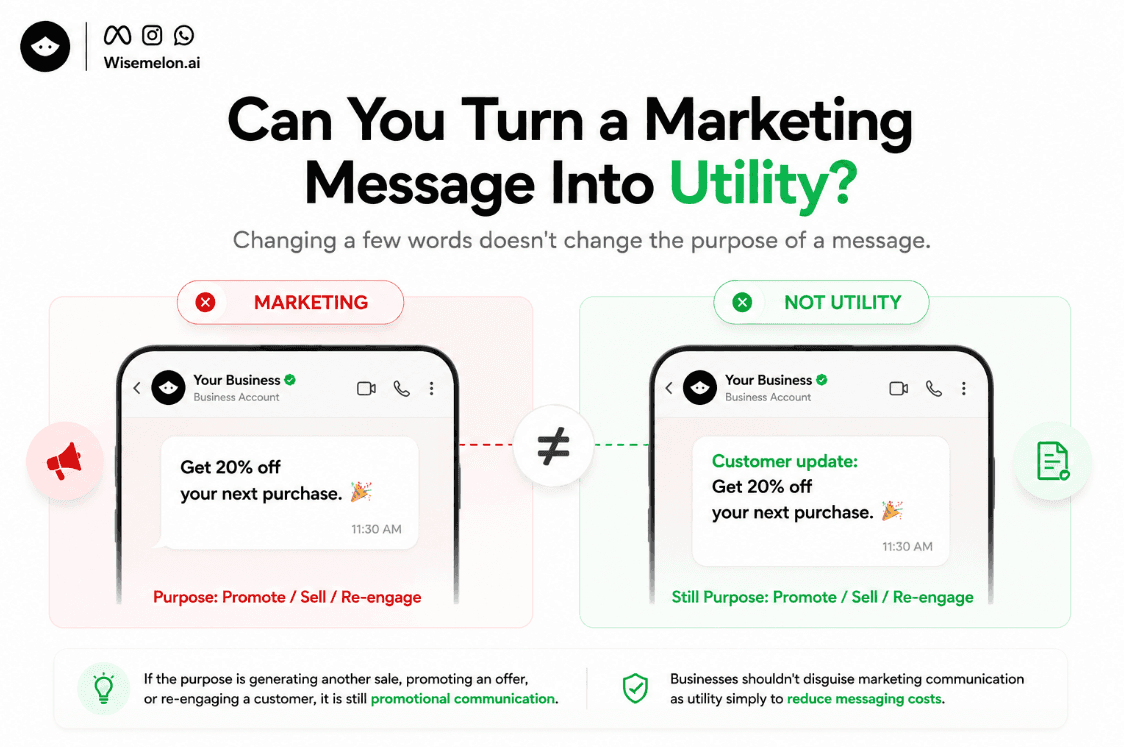
Changing a few words doesn't change the purpose of a message.
For example:
"Get 20% off your next purchase."
is clearly marketing.
Changing it to:
"Customer update: Get 20% off your next purchase."
doesn't suddenly make it utility.
If the purpose is generating another sale, promoting an offer, or re-engaging a customer, it is still promotional communication.
Businesses shouldn't disguise marketing communication as utility simply to reduce messaging costs.
Real Examples: Marketing or Utility?
Message | Category |
|---|---|
"Your order #4821 has been shipped." | Utility |
"Buy again today and get 15% off." | Marketing |
"Your payment has been successfully received." | Utility |
"Our new collection is now available." | Marketing |
"Your order will arrive tomorrow." | Utility |
"Upgrade your plan and save 20%." | Marketing |
"Your subscription renewal was successful." | Utility |
"It's been 60 days since your last purchase. Here's ₹200 off." | Marketing |
"Your refund has been processed." | Utility |
"Customers who bought this also liked our premium package." | Marketing |
Which Message Category Should You Use?
Use customer intent as the starting point.
Did the customer already request, purchase, order, or initiate something?
Yes
↓
Is the message primarily providing information about that existing action?
↓
Potentially Utility
But:
Are you trying to generate new interest, encourage another purchase, promote something, or re-engage the customer?
Yes
↓
Likely Marketing
When classification isn't clear, businesses should check Meta's latest template category requirements before submitting the message.
How Message Category Affects Campaign Economics
Businesses shouldn't think about marketing and utility messages separately from the customer journey.
Consider a typical journey:
Ad
↓
Customer starts a conversation
↓
Explores a product
↓
Places an order
↓
Receives order and delivery updates
↓
Completes purchase
↓
Receives follow-up communication
↓
Later enters a re-engagement campaign
Different stages require different communication.
Order and transaction updates may be utility communication, while later product recommendations, retargeting, and re-engagement may require marketing messages.
This is why businesses should optimize the complete customer journey, not just individual message costs.
Build the Customer Journey, Not Just the Message
Modern WhatsApp marketing requires more than sending templates.
Businesses need to understand where customers are in the journey and communicate accordingly.
Using an official WhatsApp Business API platform like Wisemelon, businesses can combine messaging with:
Automated customer journeys
AI-powered conversations
Behaviour-based retargeting
Drip sequences
Automated nudges
Interactive and carousel campaigns
Customer journey analytics
For example, if someone stops midway through a product flow, an automated nudge can reconnect with them.
If they're not ready to purchase, a drip sequence can continue communication over the following days.
After they purchase, relevant transactional updates can support the experience.
Later, when appropriate, the customer can enter a marketing or re-engagement journey.
The objective isn't to make every message utility.
It's to send the right type of message at the right stage of the customer journey.
Final Thoughts
WhatsApp marketing and utility messages serve different purposes.
Marketing messages help businesses generate demand, promote products, retarget customers, and drive repeat sales.
Utility messages provide expected information related to existing customer actions, transactions, orders, or accounts.
Instead of choosing a category based only on price, ask:
Why are we contacting this customer, and what stage of the journey are they in?
Once that is clear, choosing the right message category becomes much easier.
Frequently Asked Questions
What is a WhatsApp utility message?
A utility message generally provides information related to an existing transaction, order, account, or customer-initiated action.
What's the difference between marketing and utility templates?
Marketing templates are generally used to generate demand or promote something. Utility templates support existing customer transactions or expected service communication.
Are utility messages cheaper?
Pricing can differ by category and destination market. Always check Meta's latest official WhatsApp Business Platform rates.
Can promotional content be included in utility templates?
Businesses shouldn't use utility templates to disguise promotional communication. Promotional content can affect template classification.
Why did Meta change my template category?
Meta may determine that the actual purpose or content of your template better matches another message category.
Newsletter
Enjoyed this read? Subscribe.
Discover design insights, project updates, and tips to elevate your work straight to your inbox.
Unsubscribe at any time
Updated on