Why Hospitals Have HIMS, EMR & Billing Software - But Still Lose Patients | Wisemelon

Written By
Teja
Hospitals invest in HIMS, EMR, and billing software, but many still struggle with patient retention. Learn why Patient Engagement Platforms help improve follow-ups, communication, and patient loyalty.

Why Hospitals Have HIMS, EMR & Billing Software - But Still Lose Patients
Every modern hospital has invested in technology.
There's an HIMS to manage operations.
An EMR to store patient records.
Billing software to handle payments.
Lab software for diagnostics.
Appointment software for scheduling.
On paper, it looks like hospitals have everything they need to operate efficiently.
But here's the question that matters:
If hospitals already have all these systems, why do patients still miss appointments, forget follow-ups, switch to another hospital, or never return after their first visit?
The answer is simple.
Most hospital software is designed to help hospitals manage patients - not to help hospitals engage with patients.
And that's the missing piece.
Hospitals Have Built Great Internal Systems
Over the last decade, hospitals have spent millions implementing digital solutions.
Today's healthcare organizations commonly use:
Hospital Information Management Systems (HIMS)
Electronic Medical Records (EMR)
Billing & Insurance Software
Laboratory Information Systems (LIS)
Pharmacy Management Systems
Radiology Information Systems (RIS)
These platforms are essential.
They improve administration, streamline workflows, reduce paperwork, and help hospitals operate efficiently.
But almost every one of these systems shares the same limitation.
They primarily work inside the hospital.
Very few of them continue the conversation after patients walk out the door.
Technology Stops at the Reception Desk
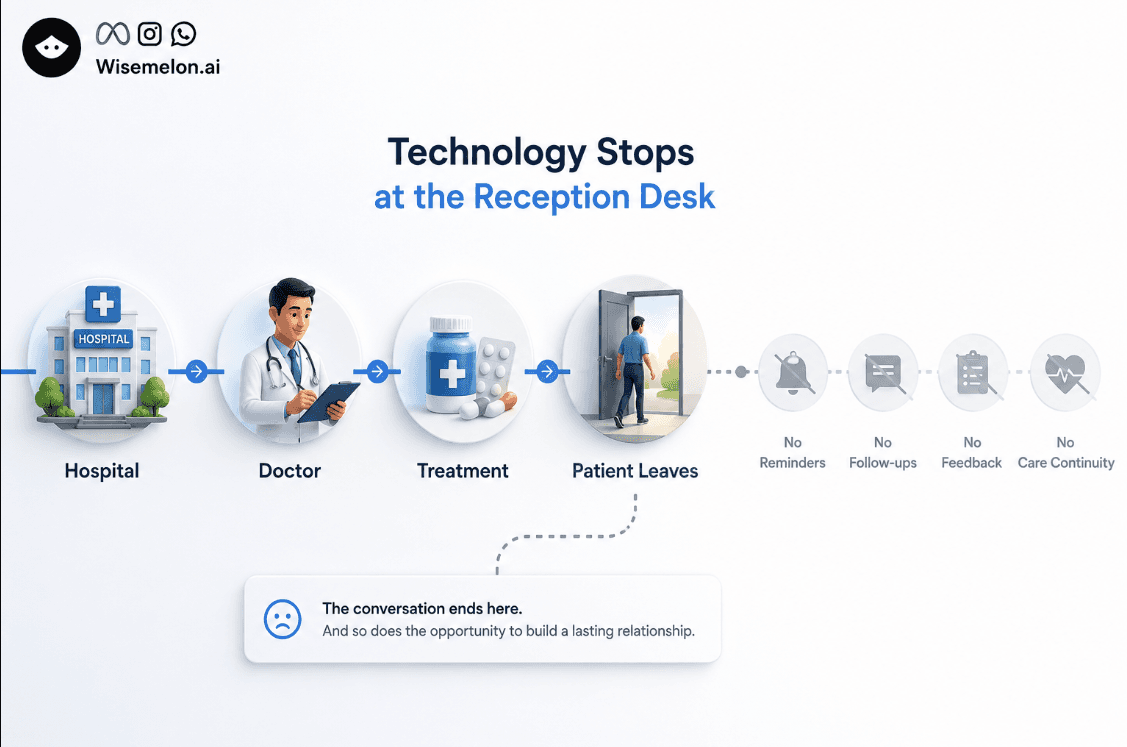
Think about a patient's journey.
They discover your hospital.
Book an appointment.
Visit the doctor.
Complete treatment.
Leave.
Now ask yourself:
What happens next?
In many hospitals, the answer is...
Nothing.
No personalized follow-up.
No medication reminders.
No preventive health campaigns.
No feedback request.
No wellness check-in.
No reminder for the next consultation.
The relationship often ends after the consultation—even though healthcare should continue beyond it.
This is where hospitals unknowingly lose patients.
The Hidden Cost of Poor Patient Engagement
Patient engagement isn't just about communication.
It directly impacts both patient outcomes and hospital revenue.
When patients don't hear from their healthcare provider, several problems arise:
Missed appointments increase.
Follow-up consultations are forgotten.
Preventive care gets delayed.
Medication adherence declines.
Patient satisfaction drops.
Online reviews decrease.
Patients choose another provider for future care.
Every missed follow-up is more than a scheduling issue - it represents a lost opportunity to improve patient outcomes while reducing the patient's lifetime value to the hospital.
What Does a Patient Engagement Platform Actually Do?
A modern Patient Engagement Platform helps hospitals automate communication throughout the patient journey.
Before the Appointment
Appointment confirmations
Automated reminders
Digital registration forms
Location directions
Preparation instructions
During the Visit
Queue updates
Document sharing
Care instructions
Instant patient support
After the Visit
Follow-up reminders
Prescription reminders
Feedback collection
Health education campaigns
Preventive care reminders
Annual health check notifications
Instead of ending communication after discharge, hospitals continue delivering value throughout the patient's healthcare journey.
Why WhatsApp Is Becoming the Preferred Patient Communication Channel
Patients don't want another mobile app they'll rarely open.
They already spend time on WhatsApp every day.
That makes it one of the most effective channels for healthcare communication.
Hospitals can use WhatsApp to:
Confirm appointments
Send reminders
Share lab reports securely
Deliver prescription instructions
Answer common patient questions
Collect feedback
Share preventive healthcare tips
Encourage follow-up visits
This creates a smoother patient experience while reducing manual work for hospital staff.
Better Engagement Leads to Better Outcomes
Hospitals often measure success using metrics like occupancy, consultation volume, and billing.
But patient engagement has a direct influence on all of them.
Effective communication helps improve:
Appointment attendance
Follow-up completion rates
Medication adherence
Patient satisfaction
Online reputation
Operational efficiency
Patient retention
Long-term loyalty
When patients feel supported beyond their hospital visit, they're more likely to trust the hospital, return for future care, and recommend it to their family and friends.
The Missing Piece: Patient Engagement
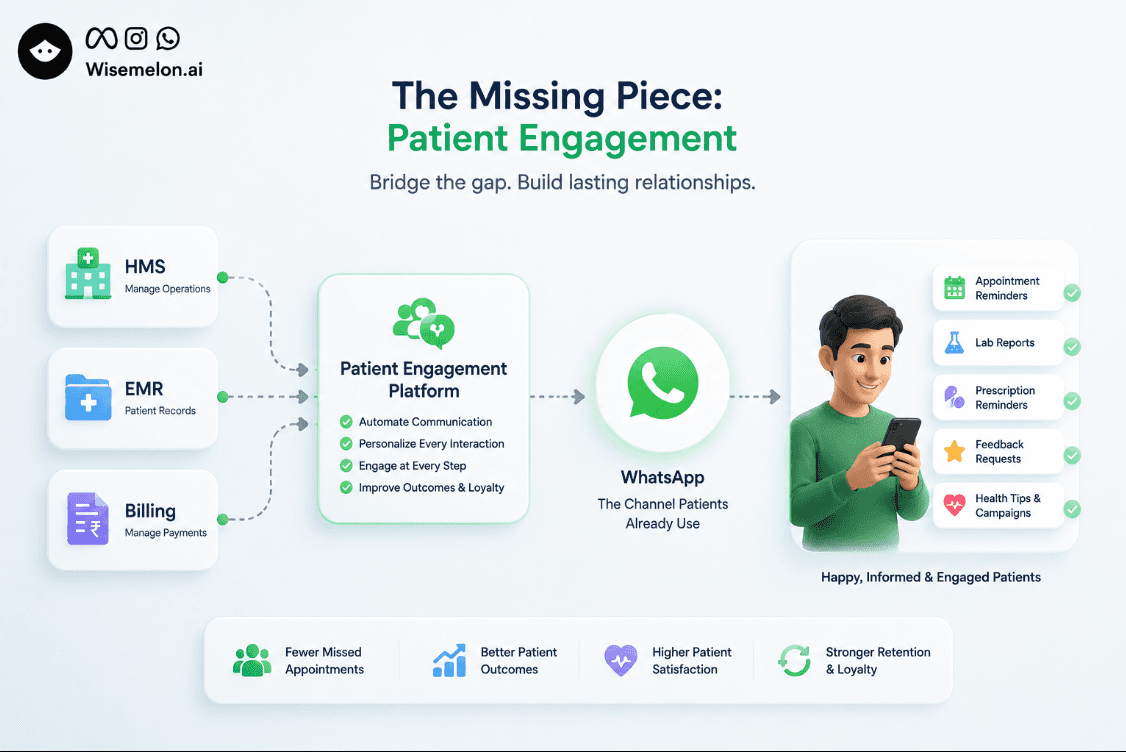
Hospitals have already invested in HIMS, EMR, billing software, and other operational systems. These solutions are essential for managing hospital workflows, clinical records, and administration - but they're not designed to maintain ongoing communication with patients.
That's where a Patient Engagement Platform comes in.
Platforms like Wisemelon serve as this engagement layer, integrating with your existing HIMS and EMR to deliver timely, personalized communication through channels like WhatsApp.
By integrating with existing hospital systems, platforms like Wisemelon enable hospitals to:
Automate appointment confirmations and reminders
Reduce missed appointments and no-shows
Send follow-up consultation reminders
Share lab reports and discharge instructions securely
Deliver medication and wellness reminders
Collect patient feedback automatically
Run preventive healthcare and awareness campaigns
Answer common patient queries using AI-powered automation
Keep patients engaged throughout their healthcare journey
Rather than replacing your existing technology investments, a Patient Engagement Platform extends their value by ensuring that the information stored in your HIMS or EMR reaches patients at the right time, through the right channel.
Final Thoughts
Modern hospitals don't need more internal software - they need a way to transform those existing systems into better patient experiences.
A Patient Engagement Platform, such as Wisemelon, fills this gap by helping hospitals communicate proactively, automate routine interactions, and build stronger relationships with patients before, during, and after every visit.
In today's healthcare landscape, managing patients is only half the journey.
Keeping them informed, connected, and engaged is what truly builds trust, improves outcomes, and turns first-time visitors into lifelong patients.
Frequently Asked Questions (FAQs)
1. What is the difference between a Hospital Information Management System (HIMS) and a Patient Engagement Platform?
A Hospital Information Management System (HIMS) is designed to manage hospital operations such as appointments, billing, patient records, and clinical workflows. A Patient Engagement Platform complements these systems by helping hospitals communicate with patients through appointment reminders, follow-ups, medication alerts, feedback collection, and personalized health updates.
2. Why isn't HIMS or EMR enough to improve patient retention?
HIMS and EMR are primarily built for managing internal hospital processes and clinical data. They typically don't provide ongoing patient communication after a visit. Without timely follow-ups and engagement, patients are more likely to miss appointments, switch providers, or discontinue their care.
3. How can WhatsApp improve patient engagement in hospitals?
WhatsApp allows hospitals to communicate with patients through a channel they already use every day. Hospitals can send appointment reminders, follow-up notifications, lab reports, prescription instructions, wellness campaigns, and feedback requests, making communication faster, more convenient, and more effective.
4. Can a Patient Engagement Platform integrate with existing hospital software?
Yes. Most modern Patient Engagement Platforms like wisemelon are designed to integrate with existing HIMS, EMR, billing systems, and other healthcare software. This allows hospitals to automate patient communication without replacing their current technology investments.
5. What are the benefits of implementing a Patient Engagement Platform?
A Patient Engagement Platform like wisemelon helps hospitals reduce missed appointments, improve follow-up rates, increase medication adherence, enhance patient satisfaction, strengthen long-term patient relationships, and improve overall operational efficiency through automated, personalized communication.
Newsletter
Enjoyed this read? Subscribe.
Discover design insights, project updates, and tips to elevate your work straight to your inbox.
Unsubscribe at any time
Written By
Teja
Updated on