WhatsApp Patient Follow-Up: How Hospitals Can Automate Patient Communication After Every Visit

Written By
Teja
Learn how hospitals can automate patient follow-up on WhatsApp, including appointment reminders, post-discharge communication, reports, AI support and human escalation.
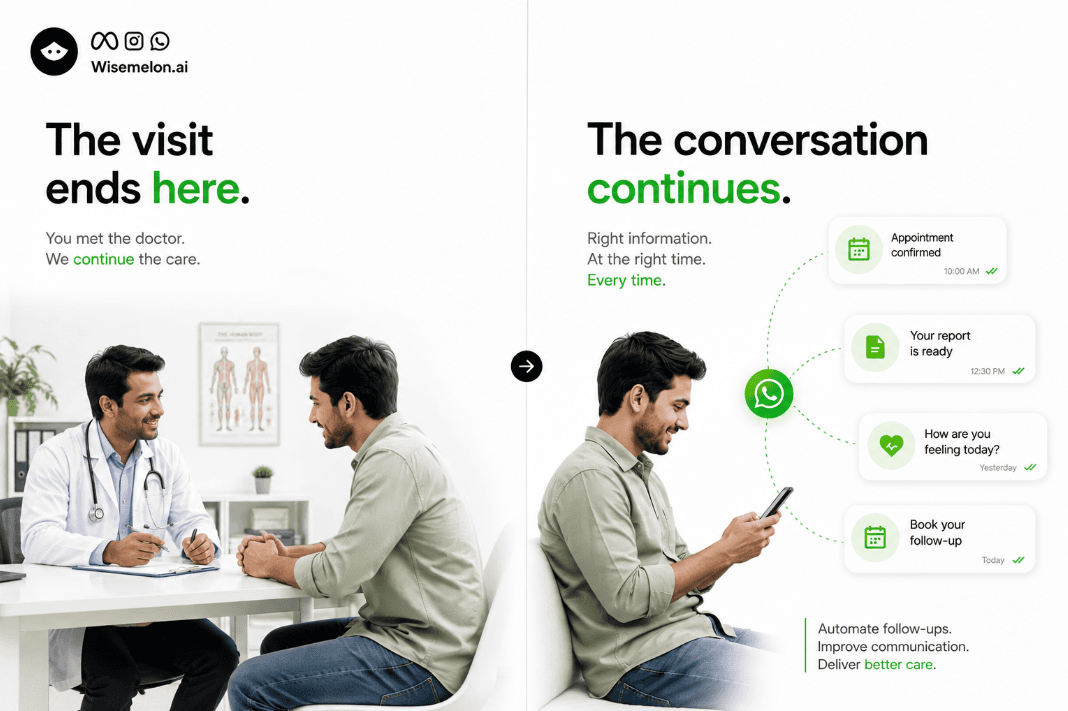
WhatsApp Patient Follow-Up: How Hospitals Can Automate Patient Communication After Every Visit
A patient's hospital visit may end when they leave the hospital.
The communication shouldn't.
After an appointment, procedure, surgery, diagnostic test, or discharge, patients often still have questions:
When should I come back?
Is my report ready?
What do I need to do next?
Can I reschedule my appointment?
For hospitals, answering these questions manually across hundreds or thousands of patients can quickly become difficult.
This is where WhatsApp patient follow-up can help.
With the WhatsApp Business Platform, hospitals can automate routine communication, allow patients to respond, and route conversations to staff when human attention is needed.
The goal isn't simply to send more messages.
It's to make sure the next useful patient interaction happens at the right time.
What Is WhatsApp Patient Follow-Up?
WhatsApp patient follow-up is the use of WhatsApp-based messaging, automation, and conversational workflows to communicate with patients after an appointment, procedure, diagnostic test, or hospital discharge.
Hospitals can use it for:
Appointment reminders and confirmations
Post-visit instructions
Follow-up appointment booking
Report-ready notifications
Post-discharge communication
Routine recovery check-ins
Patient feedback
Administrative questions
Human support and escalation
Instead of treating every message as a separate interaction, hospitals can build a continuous communication journey around the patient.
Why Is Patient Follow-Up Difficult for Hospitals?
The patient journey doesn't stop at the consultation.
It often looks like:
Appointment → Consultation → Test/Procedure → Discharge → Follow-up → Next Appointment
The hospital manages most of these events through internal systems.
But once the patient leaves, communication often becomes manual.
A receptionist may need to make calls.
A nurse may need to remember follow-ups.
Patients may forget appointments.
Patients may call repeatedly asking whether their report is ready.
And when patient volume increases, maintaining consistent follow-up becomes harder.
This is why healthcare organizations are increasingly looking at digital patient-engagement systems that connect communication with existing hospital workflows.
The shift is from sending messages to managing patient conversations.
How Hospitals Can Use WhatsApp for Patient Follow-Up
1. Appointment Reminders and Confirmations
Instead of simply sending:
Your appointment is tomorrow.
A hospital can create a two-way conversation:
Hi Priya, your follow-up appointment with Dr. Rao is scheduled for Thursday at 11:00 AM.
Would you like to confirm or reschedule?
Confirm | Reschedule
The patient can take action immediately instead of calling the hospital.
2. Post-Procedure and Post-Discharge Follow-Up
After a procedure or discharge, hospitals may need to maintain communication with patients during recovery.
A structured workflow could send approved messages at appropriate intervals:
Day 1: Follow-up information
Day 3: Routine check-in
Day 7: Follow-up appointment reminder
Later: Additional communication based on the care pathway
Healthcare automation platforms are increasingly offering post-operative and post-discharge workflows for exactly this purpose.
These workflows should always be designed around the appropriate clinical protocols rather than treating automation as a replacement for medical care.
3. Reports, Tests and Follow-Up Appointments
One common patient question is:
“Is my report ready?”
Instead of requiring patients to call the hospital, a connected workflow can notify them when a report becomes available and provide the appropriate next step.
For example:
Report ready → WhatsApp notification → Secure access → Follow-up appointment option
This becomes even more useful when communication is connected to the hospital's existing systems.
India's Ayushman Bharat Digital Mission (ABDM) is also building infrastructure around interoperable digital health records and consent-based sharing, making responsible handling of patient information increasingly important.
4. Routine Patient Questions
Not every patient question requires a doctor.
Patients may ask:
What time is my appointment?
How can I reschedule?
Where is the department?
What documents should I bring?
How can I contact billing?
When is my next appointment?
These are good candidates for automation.
An AI assistant can also help understand natural-language requests and route conversations to the appropriate team.
For example:
“I can't come tomorrow. Can I see the doctor next week after 5?”
Instead of forcing the patient through a menu, an AI-powered workflow can understand the request and move them toward the appropriate scheduling option.
However, healthcare AI should know when not to answer. Recent research continues to highlight the importance of context, safety, governance, and human oversight in patient-facing AI systems.
WhatsApp Automation vs AI in Patient Follow-Up
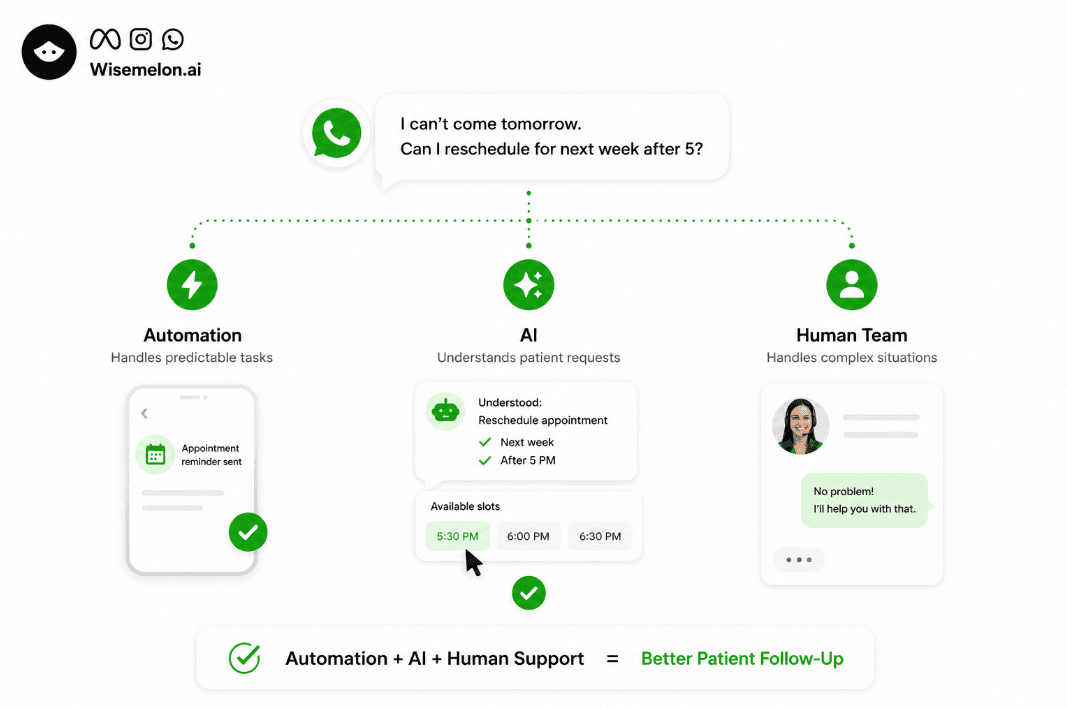
These are often confused, but they solve different problems.
Automation
Automation follows predefined rules.
Appointment tomorrow → send reminder.
Patient confirms → update status.
Patient requests rescheduling → show available slots.
AI
AI becomes useful when the conversation isn't predictable.
A patient might type:
“I need to move my appointment to sometime next week after work.”
AI can understand the intent and guide the patient toward the right workflow.
The strongest approach isn't automation vs AI.
It's:
Automation for predictable tasks + AI for conversational understanding + humans for situations requiring judgment.
What Should Hospitals Automate?
Hospitals don't need to automate everything.
Good candidates include:
Appointment reminders
Confirmations and rescheduling
Report notifications
Routine administrative FAQs
Feedback collection
Follow-up reminders
Registration instructions
Non-clinical patient support
Human or clinical oversight is still essential for:
Diagnosis
Emergency situations
Medication changes
Treatment decisions
Complex symptoms
Clinical interpretation
The objective should be:
Automate what is repetitive. Escalate what requires judgment.
Why Integration Matters
A WhatsApp number alone doesn't create a patient communication system.
The real value comes when WhatsApp connects with the systems the hospital already uses.
A typical workflow can look like:
Hospital System
↓
Patient event
↓
Communication platform
↓
↓
Patient response
↓
Automation / AI
↓
Human team when required
This is why hospitals should look for an official WhatsApp Business Platform solution with flexible APIs, automation, integrations, conversation history, and human handoff.
Platforms such as Wisemelon can fit into this layer, allowing healthcare teams to build WhatsApp conversations around their existing workflows rather than treating WhatsApp as a separate messaging tool.
The important distinction is:
Don't choose a platform just because it can send WhatsApp messages.
Choose one that can help manage what happens after the patient replies.
What Should Hospitals Look for in a WhatsApp Patient Follow-Up Platform?
Before choosing a platform, healthcare teams should ask:
Can patients reply?
Two-way communication is more useful than one-way notifications.
Can it integrate with existing systems?
APIs, webhooks, CRM and hospital-system integrations can prevent teams from manually moving information between platforms.
Can it automate workflows?
Look for event-based automation rather than only bulk messaging.
Can staff take over?
Patients should be able to move from automation to a human when necessary.
Can it use AI responsibly?
Hospitals should know what the AI can access, what it can answer, and when it escalates.
Can it handle patient information appropriately?
Consent, access controls, data handling, and privacy should be considered before deploying healthcare communication workflows.
The Future of Patient Follow-Up Is Conversational
Healthcare has traditionally been organized around appointments.
A patient books.
The patient visits.
The appointment ends.
But the patient's healthcare journey continues.
The next generation of patient engagement will increasingly focus on what happens between those appointments.
Before the visit:
Reminders → preparation
After the visit:
Instructions → follow-up
After discharge:
Check-ins → support
Between visits:
Reminders → next appointment
When something needs attention:
Conversation → human team
WhatsApp can become one of the communication layers connecting these moments.
The goal isn't to turn hospitals into chatbots.
It's to make sure that when a patient needs the next useful interaction, the hospital can provide it.
Final Takeaway
The biggest opportunity in healthcare communication isn't sending another reminder.
It's closing the gap between what happens inside the hospital and what happens after the patient leaves.
A patient shouldn't have to remember every next step.
A receptionist shouldn't have to answer the same question hundreds of times.
A nurse shouldn't have to manually follow up with every patient.
And an AI system shouldn't pretend to be a doctor.
The better model is:
Automate the predictable.
Use AI where conversation needs understanding.
Bring humans in where judgment matters.
And connect all three through a patient communication workflow.
Because the hospital visit may end at the door.
The patient journey doesn't.
Frequently Asked Questions
What is WhatsApp patient follow-up?
WhatsApp patient follow-up is the use of WhatsApp messaging and automation to communicate with patients after appointments, procedures, tests, or discharge.
Can hospitals automate patient follow-up on WhatsApp?
Yes. Hospitals can create workflows for appointment reminders, confirmations, follow-ups, report notifications, feedback, and routine administrative communication.
Can WhatsApp be used for post-discharge follow-up?
Yes. Hospitals can use WhatsApp for approved discharge information, follow-up reminders, routine check-ins, and appointment communication, with appropriate clinical oversight.
Can AI handle patient follow-up?
AI can assist with routine questions, scheduling, intent detection, routing, and conversation management. Clinical decisions and situations requiring professional judgment should remain under appropriate human oversight.
What is the difference between WhatsApp automation and an AI chatbot?
Automation follows predefined rules, while AI can understand more flexible natural-language conversations. They can work together in the same patient communication workflow.
Can WhatsApp integrate with hospital systems?
Yes. Healthcare communication platforms can use APIs, webhooks, CRM integrations, and other connectivity methods to connect patient events with WhatsApp workflows.
Is WhatsApp suitable for healthcare communication?
It can be, when deployed through the appropriate official WhatsApp Business Platform infrastructure and supported by suitable privacy, consent, security, access-control, and healthcare workflows.
Newsletter
Enjoyed this read? Subscribe.
Discover design insights, project updates, and tips to elevate your work straight to your inbox.
Unsubscribe at any time
Written By
Teja
Updated on


