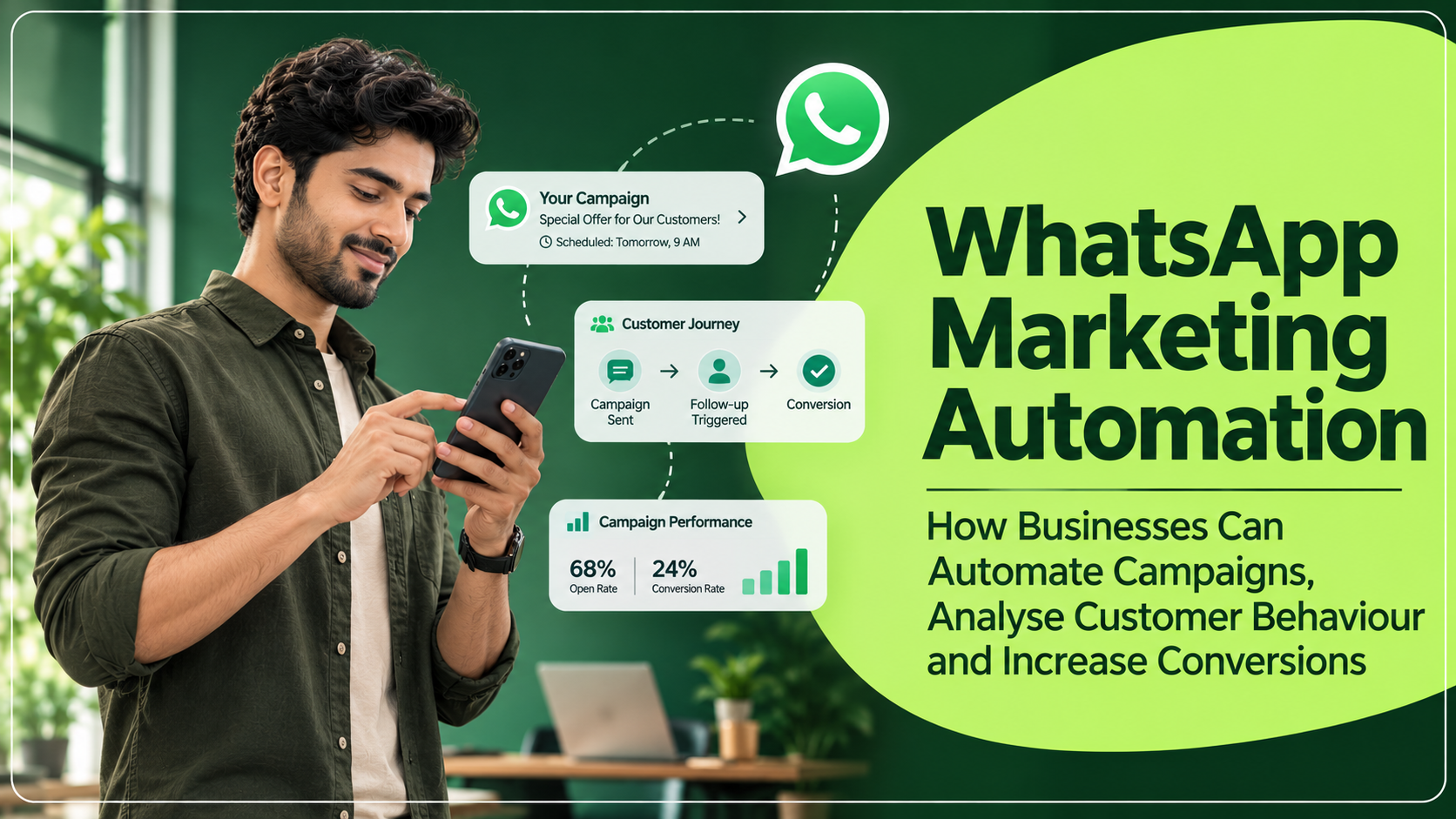
WhatsApp Marketing Automation: How Businesses Can Automate Campaigns, Analyse Customer Behaviour and Increase Conversions
Discover WhatsApp marketing automation with AI-powered campaigns, customer behaviour analysis, interactive webviews, CRM and automated follow-ups. Boost engagement and conversions.
Teja
WhatsApp Business API·14 min read
In this article 10 sectionsWhatsApp Marketing Automation: How Businesses Can Automate Campaigns, Analyse Customer Behaviour and Increase Conversions
Businesses today are using WhatsApp for more than just communicating with customers. It has become an important channel for marketing campaigns, lead generation, customer engagement, sales follow-ups and business communication.
However, managing all these activities manually can become difficult as a business grows. Sending individual messages, following up with leads, managing customer enquiries and tracking campaign performance require considerable time and effort.
This is where WhatsApp marketing automation becomes valuable.
With the right automation strategy, businesses can create personalised customer journeys, schedule campaigns, automatically follow up with potential customers, analyse customer interactions and improve their marketing performance.
Modern marketing automation goes beyond sending bulk messages. It combines artificial intelligence, customer relationship management (CRM), interactive web experiences, behavioural analytics and automated workflows to create connected customer experiences.
In this guide, we explore how WhatsApp marketing automation works, its key features, practical use cases and how businesses can use AI to improve customer engagement and conversions.
What Is WhatsApp Marketing Automation?
WhatsApp marketing automation is the process of using software, workflows and artificial intelligence to automate marketing activities and customer communication through WhatsApp.
Instead of manually sending messages and following up with every customer, businesses can create automated processes that respond to customer actions, schedule campaigns and deliver relevant information at the right time.
For example, when a customer submits an enquiry form, a business can automatically:
Capture the customer's contact information.
Add the lead to its CRM.
Send a WhatsApp confirmation message.
Share relevant product or service information.
Assign the enquiry to a sales representative.
Schedule follow-up messages.
Track the customer's engagement.
All these activities can be connected through an automated marketing workflow.
WhatsApp marketing automation helps businesses reduce repetitive work, improve response times and create more consistent customer experiences.
Why Do Businesses Need WhatsApp Marketing Automation?
Traditional marketing often involves managing multiple activities across different applications.
Marketing teams collect leads, maintain spreadsheets, send campaigns, follow up with customers and manually monitor campaign performance.
As customer volumes increase, managing these activities becomes increasingly complicated.
WhatsApp marketing automation helps solve several common business challenges.
1. Manual Customer Follow-ups
Businesses frequently lose potential customers because they forget to follow up after an initial enquiry.
Automation allows businesses to schedule reminders and follow-up messages based on customer interactions.
2. Disconnected Customer Information
Customer information may be scattered across spreadsheets, websites, CRM applications and messaging platforms.
A connected CRM system helps businesses maintain customer information and communication history in one place.
3. Generic Marketing Campaigns
Sending the same message to every customer does not always produce meaningful engagement.
Customer segmentation and behavioural analysis help businesses create more relevant campaigns.
4. Limited Campaign Insights
Knowing how many messages were delivered is not enough to understand marketing performance.
Businesses also need to understand customer clicks, website activity, form submissions, purchases and drop-offs.
5. Repetitive Marketing Activities
Marketing teams spend time performing repetitive tasks such as sending reminders, assigning leads and updating customer records.
Automated workflows can handle these processes and allow teams to focus on more important activities.
How Does WhatsApp Marketing Automation Work?
A complete WhatsApp marketing automation process connects different customer touchpoints into one continuous journey.
A typical workflow includes the following stages.
Step 1: Capture Customer Leads
The customer journey begins when someone interacts with a business.
Leads can come from:
Website enquiry forms.
Landing pages.
Social media advertisements.
Click-to-WhatsApp advertisements.
QR codes.
Existing customer databases.
Product and service enquiries.
The captured information can be added to a CRM system for further communication.
Step 2: Segment Customers
Not every customer has the same interests or requirements.
Businesses can organise contacts based on different attributes, such as:
Customer interests.
Previous purchases.
Enquiry type.
Location.
Lead source.
Purchase history.
Subscription status.
Previous campaign engagement.
Segmentation makes it easier to send relevant messages to different customer groups.
Step 3: Create and Schedule WhatsApp Campaigns
Businesses can create marketing campaigns for specific customer segments.
Campaigns can be scheduled for suitable dates and times, allowing marketing teams to plan communication in advance.
Common campaign examples include:
Product launches.
Special offers.
Seasonal promotions.
Event announcements.
New service updates.
Customer re-engagement campaigns.
Business-initiated WhatsApp messages must follow Meta's approved template and messaging requirements.
Step 4: Automate Customer Journeys
After a customer interacts with a campaign, the next communication can be based on their actions.
For example:
A customer clicks a product link and receives relevant product information.
A customer submits an enquiry and receives a confirmation.
A customer starts a booking but does not complete it and receives an appropriate follow-up.
A customer purchases a product and receives order-related updates.
These interactions can trigger automated workflows when the required events and integrations are configured.
Step 5: Analyse Customer Behaviour
Businesses can analyse how customers interact with messages, links, landing pages and forms.
This information helps marketing teams understand customer interests, identify drop-off points and improve future campaigns.
Step 6: Optimise Campaign Performance
Campaign analytics help businesses evaluate their results.
Marketing teams can review delivery rates, read rates, replies, clicks, conversions and other available performance indicators.
The insights can be used to improve targeting, content and customer journeys.
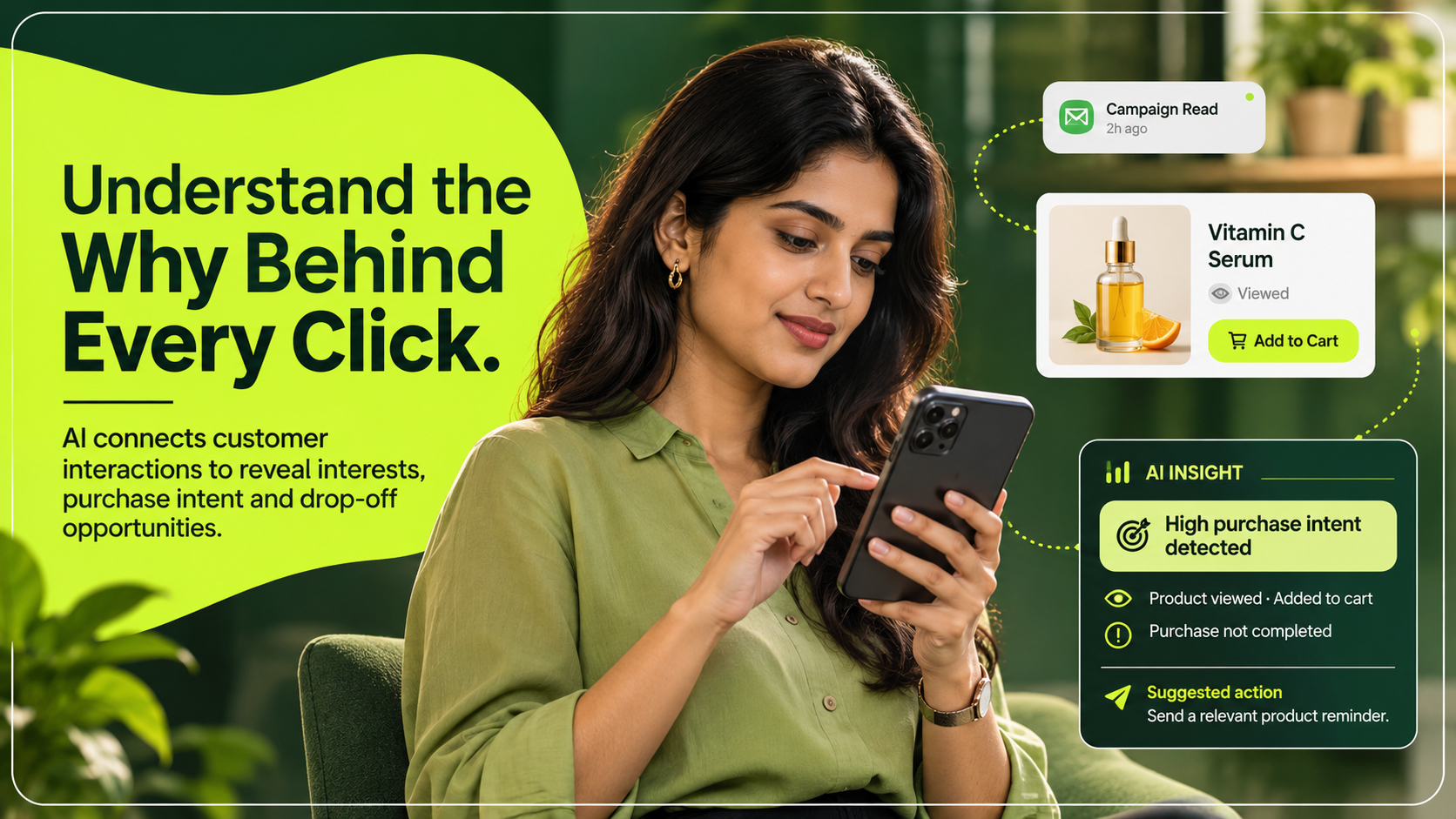
AI-Powered Customer Behaviour Analysis: Understand What Customers Actually Do
Traditional marketing analytics mainly focuses on campaign-level metrics such as messages sent, delivered, read and replied to.
However, these numbers do not always explain what customers are interested in or why they leave without completing an action.
This is where AI-powered customer behaviour analysis can add another layer of intelligence.
Instead of looking only at message engagement, businesses can analyse customer interactions across connected marketing touchpoints.
What Can Businesses Analyse?
1. Message Engagement
Understand which campaigns customers read, reply to or interact with.
2. Link Click Behaviour
Track which campaign links customers click and identify the products, services or offers attracting attention.
3. Landing Page Interactions
Understand which sections of a landing page customers visit and which elements receive attention.
4. Form Engagement
Analyse form interactions, including started forms, completed forms and configured partial-submission events.
5. Product Interest
When ecommerce events are connected, businesses can identify products customers view, add to their carts or purchase.
6. Customer Drop-offs
Identify where customers leave a journey, such as after clicking an advertisement, visiting a landing page or starting an enquiry.
How AI Can Turn Behaviour Into Marketing Decisions
Collecting customer data is only the first step. The real value comes from using that information to make better decisions.
Generate insights from campaign and website interactions.
Recommend improvements to customer journeys.
For example, imagine a customer receives a WhatsApp campaign promoting three different products.
The customer clicks on the second product, visits its landing page and adds it to their cart but does not complete the purchase.
A connected marketing system can record these events, associate them with the customer where permitted and use them to trigger a relevant follow-up journey.
Rather than sending another generic promotional message, the business can share relevant product information or an appropriate reminder.
This transforms marketing from simple message distribution into behaviour-driven customer engagement.
Webviews: Turn WhatsApp Campaigns Into Interactive Experiences
One limitation of traditional WhatsApp campaigns is that businesses often depend on external websites to complete important customer actions.
Customers may receive a message, click a link, open a website and navigate through several steps before completing an enquiry or purchase.
Every additional step creates another opportunity for customers to leave.
Webviews offer businesses another way to create interactive customer experiences.
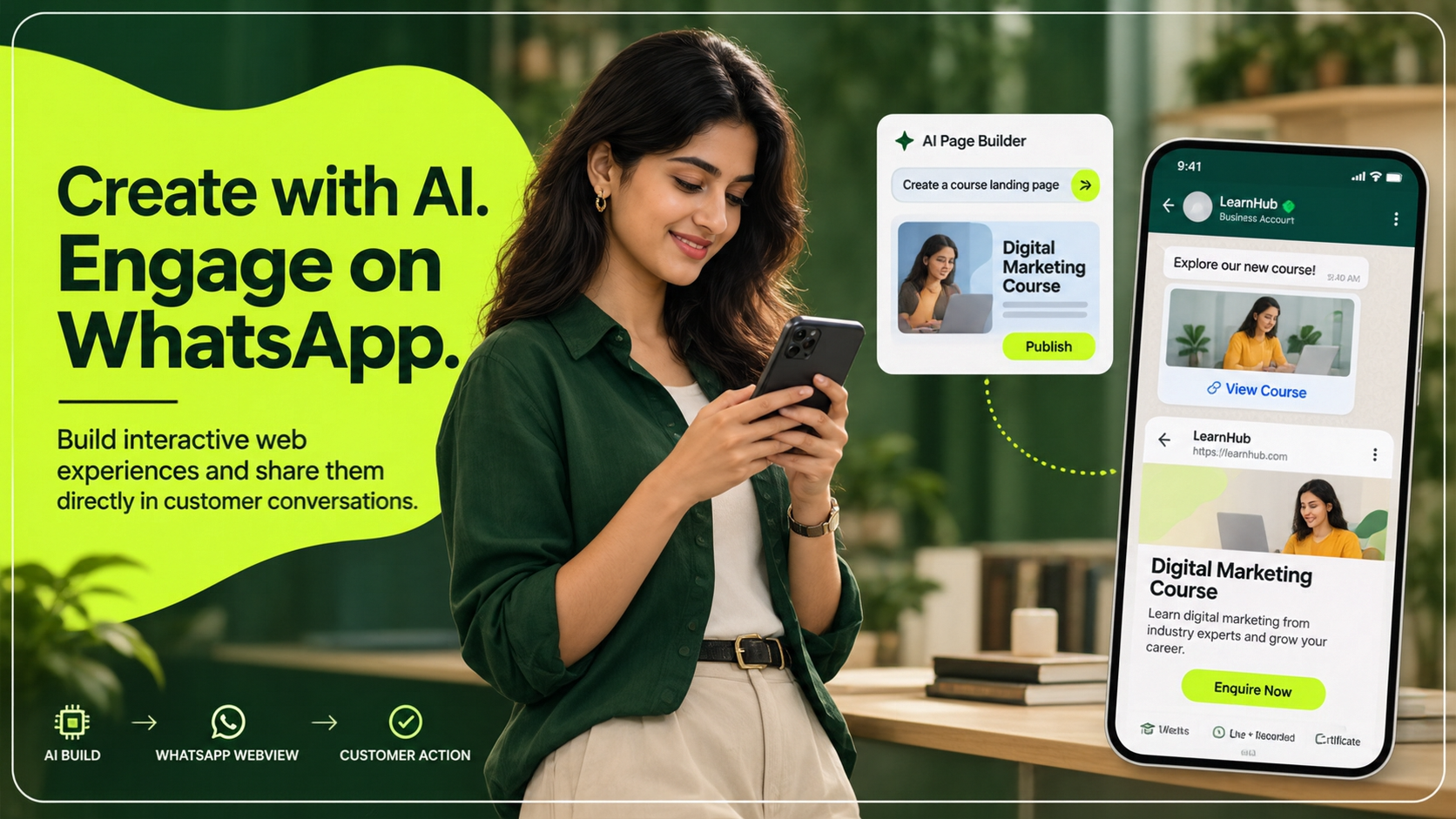
A webview is an interactive web page that customers can open through a link shared in a WhatsApp conversation.
Businesses can use these experiences for lead generation, product discovery, bookings, registrations, enquiries and other customer interactions.
Create Webviews Using AI Instead of building every landing page manually, businesses can use AI to generate web experiences based on their requirements.
For example, a business can create:
Product landing pages.
Lead generation forms.
Appointment booking pages.
Event registration pages.
Product catalogues.
Customer enquiry pages.
Feedback and survey forms.
Promotional campaign pages.
AI can help generate the page structure, content and layout. Businesses can review, customize and publish the experience.
Publish and Connect Webviews to WhatsApp Campaigns
Once a webview is ready, businesses can publish it and share its link through WhatsApp campaigns.
For example, a coaching centre can send a campaign about a new course.
When a student clicks the campaign link, they can open an interactive page containing:
Course details.
Available programmes.
Course benefits.
Enquiry forms.
Registration options.
Contact information.
The customer can complete the required action through the page.
Track What Happens After a Customer Clicks
The journey does not need to end when someone clicks a WhatsApp link.
With suitable analytics and event tracking, businesses can understand what customers do after opening a webview.
They can track:
Page visits.
Button clicks.
Form interactions.
Form submissions.
Partial form details where captured and permitted.
Product views.
Add-to-cart events.
Completed purchases.
Customer drop-off points.
This information provides greater visibility into customer behaviour and helps businesses understand how marketing campaigns contribute to actual business outcomes.
WhatsApp Drip Marketing: Automate Follow-ups Based on Customer Journeys
Not every customer makes a purchase immediately after receiving a marketing message.
Some customers need additional information, while others may require reminders before making a decision.
WhatsApp drip marketing helps businesses send a planned sequence of messages over time.
Instead of sending all information in one campaign, businesses can create customer journeys with multiple communication stages.
Example of a WhatsApp Drip Marketing Journey
Imagine a customer enquires about a product.
An automated journey could look like this:
Day 1 - Initial Enquiry
Send a confirmation message and share product information.
Day 2 - Additional Information
Share product benefits, features or relevant details.
Day 4 - Customer Engagement
Send a message inviting the customer to ask questions or explore a demonstration.
Day 6 - Follow-up
Send a relevant follow-up if the customer has not completed the enquiry or purchase.
Day 8 - Re-engagement
If appropriate, send a final message with additional information or an offer.
The actual journey should adapt to customer responses and actions. Businesses should stop or adjust follow-ups when customers purchase, opt out or otherwise no longer qualify for the journey.
Behaviour-Based Drip Campaigns
More advanced journeys can respond to customer behaviour rather than relying only on fixed dates.
For example:
If a customer clicks a product link, trigger a relevant follow-up.
If a customer completes a form, move them to the next stage.
If a customer makes a purchase, stop promotional reminders for that purchase.
If a customer shows interest in a particular category, share relevant information.
If a customer does not engage, adjust the next communication.
This makes drip marketing more relevant and helps businesses avoid sending unnecessary messages.
CRM Integration: Connect Every Customer Interaction
A marketing campaign becomes more useful when customer information is connected to a CRM system.
Without a connected CRM, businesses may have to manually transfer customer details from forms, spreadsheets and WhatsApp conversations.
A connected CRM helps maintain a central view of customer information.
What Can a WhatsApp CRM Manage?
Customer names and contact details.
Lead sources.
Enquiry history.
Customer interests.
Purchase information.
Follow-up status.
Assigned sales representatives.
Previous conversations.
Customer journey stages.
For example, when someone submits a webview enquiry form, their information can be added to the CRM and assigned to the relevant team.
The sales team can then view the enquiry, understand the customer's requirements and continue the conversation.
CRM integration also helps businesses connect marketing activity with sales outcomes.
AI Agents and Automated Customer Engagement
Marketing automation is not limited to sending scheduled messages.
Businesses also need to respond to customer questions, understand their requirements and guide them towards the next step.
AI agents can help manage these interactions.
Unlike simple automated replies, AI agents can use connected business knowledge and configured tools to support more complex customer journeys.
For example, an AI agent can:
Answer frequently asked questions.
Explain products and services.
Collect customer information.
Qualify potential leads.
Share relevant links and information.
Guide customers through configured workflows.
Connect customers with the appropriate team.
Escalate conversations to human agents when necessary.
When connected to a CRM and workflow system, AI agents can also help initiate actions based on customer interactions.
Businesses should provide clear human-support escalation options and ensure that automated communication follows WhatsApp's messaging policies.
Campaign Analytics: Measure More Than Messages Delivered
Sending thousands of messages does not necessarily mean a marketing campaign is successful.
Businesses need to understand how customers respond and whether campaigns contribute to their business objectives.
A complete marketing analytics system should monitor different stages of the customer journey.
Important WhatsApp Campaign Metrics
Delivery Rate: Percentage of messages successfully delivered.
Read Rate: Percentage of delivered messages that were read, subject to WhatsApp reporting limitations.
Reply Rate: Percentage of customers who responded to the campaign.
Click Rate: Percentage of customers who clicked campaign links, where click tracking is available.
Conversion Rate: Percentage of customers who completed a defined action, such as submitting an enquiry or purchasing a product.
Opt-out Rate: Percentage of customers who opted out of further marketing communication.
Average Response Time: Average time taken by the team or configured system to respond to customers.
Website and Webview Analytics
Businesses can extend their analytics beyond WhatsApp messaging.
With suitable event tracking, they can monitor:
Total page visits.
Unique visitors.
Traffic sources.
Button clicks.
Form starts.
Form completions.
Product interactions.
Add-to-cart activity.
Purchase events.
Drop-off points.
Combining campaign analytics with webview analytics helps businesses understand the complete customer journey rather than evaluating individual messages in isolation.
How to Choose the Right WhatsApp Marketing Automation Platform
Not every WhatsApp marketing platform offers the same capabilities.
Some platforms focus primarily on bulk messaging, while others provide CRM, automation, AI and analytics.
Before selecting a platform, businesses should evaluate the following:
Campaign Management: Can you create, schedule and manage WhatsApp campaigns?
Automation: Can you create workflows based on customer actions?
AI Capabilities: Can AI understand customer questions and support business processes?
CRM: Can you manage leads and customer information?
Webviews: Can you create interactive landing pages and forms?
Behaviour Analytics: Can you understand customer interactions beyond message delivery?
Integrations: Can the platform connect with your existing business applications?
Team Management: Can multiple employees manage customer conversations?
Reporting: Can you measure campaign performance and conversions?
Pricing: Are platform charges, agent fees and messaging costs clearly explained?
Choosing a platform that connects these capabilities can help businesses manage marketing and customer engagement more effectively.
How Wisemelon Brings WhatsApp Marketing Automation Together
Wisemelon brings WhatsApp marketing, AI-powered engagement, CRM, interactive web experiences and business intelligence together in one connected platform.
Instead of managing campaigns, customer information, landing pages and analytics separately, businesses can connect these activities through automated workflows.
Generate interactive landing pages and forms using AI, customise the experience and publish it for customers to access through campaign links.
Customer Behaviour Intelligence
Understand customer interactions across connected web experiences, including clicks, form activity, product interactions and configured conversion events.
Drip Marketing and Customer Journeys
Create automated message sequences and trigger relevant follow-ups based on customer activity and journey stages.
Connected CRM
Capture customer details, organise leads, manage customer records and connect marketing activities with sales processes.
AI Agents
Use AI agents to understand customer enquiries, provide relevant information, qualify leads and support configured business workflows.
Analytics and Business Intelligence
Bring campaign metrics, customer engagement and available behavioural data together to understand marketing performance.
With these capabilities working together, businesses can move beyond traditional bulk messaging and build connected marketing experiences. Final Thoughts
WhatsApp marketing is evolving beyond traditional broadcast campaigns.
Businesses now need more than a tool that sends messages. They need connected systems that understand customer behaviour, automate communication, manage customer information and measure business outcomes.
By combining WhatsApp campaigns, AI agents, CRM, interactive webviews, drip marketing and business intelligence, businesses can create more meaningful customer journeys.
The future of WhatsApp marketing is not simply about reaching more customers. It is about understanding them better, delivering relevant experiences and helping them take the next step.
Frequently Asked Questions About WhatsApp Marketing Automation
What is WhatsApp marketing automation?
WhatsApp marketing automation uses software, AI and workflows to automate customer communication, marketing campaigns, follow-ups and engagement through WhatsApp.
How does WhatsApp marketing automation work?
It connects customer data, campaign management, messaging templates, CRM systems and automated workflows. Customer actions can trigger relevant messages and business processes.
Can I automate WhatsApp marketing campaigns?
Yes. Businesses can use WhatsApp Business Platform providers to create and schedule campaigns, manage customer segments and automate eligible follow-ups using approved templates and messaging rules.
What is WhatsApp drip marketing?
WhatsApp drip marketing is a method of sending a planned sequence of messages to customers over time. The messages can be scheduled or triggered by customer actions.
Can AI analyse WhatsApp customer behaviour?
AI can analyse available customer interaction data, such as campaign engagement, clicks, website activity and configured conversion events. The depth of analysis depends on the data and integrations available.
What are AI-powered webviews?
AI-powered webviews are interactive web pages that businesses can generate or customise using AI and share through WhatsApp links. They can be used for enquiries, registrations, bookings, product discovery and other customer activities.
Can businesses track clicks and conversions from WhatsApp campaigns?
Yes, where appropriate tracking and integrations are implemented. Businesses can use tracked links, website events and conversion integrations to understand how customers interact with campaign destinations.
Is WhatsApp marketing automation suitable for small businesses?
Yes. Small businesses can use automation for lead management, customer enquiries, reminders, promotions and follow-ups without manually managing every interaction.
Is WhatsApp marketing automation expensive?
The cost depends on Meta's applicable messaging charges, the software provider's platform fees and the features used. Businesses should compare these costs before selecting a platform.
Is WhatsApp marketing automation better than bulk messaging?
Bulk messaging is one part of WhatsApp marketing. Automation extends beyond sending messages by connecting customer data, follow-ups, workflows, interactive experiences and analytics.